
Exhaust Technology — Deep Dive
F1 Technology
Not a muffler. Not a straight pipe. Our F1 Technology is a crossover system — a junction where the exhaust banks meet, trade pulses, and leave together. This is the engineering behind it.
The Difference
Two banks. One junction. A crossed path.
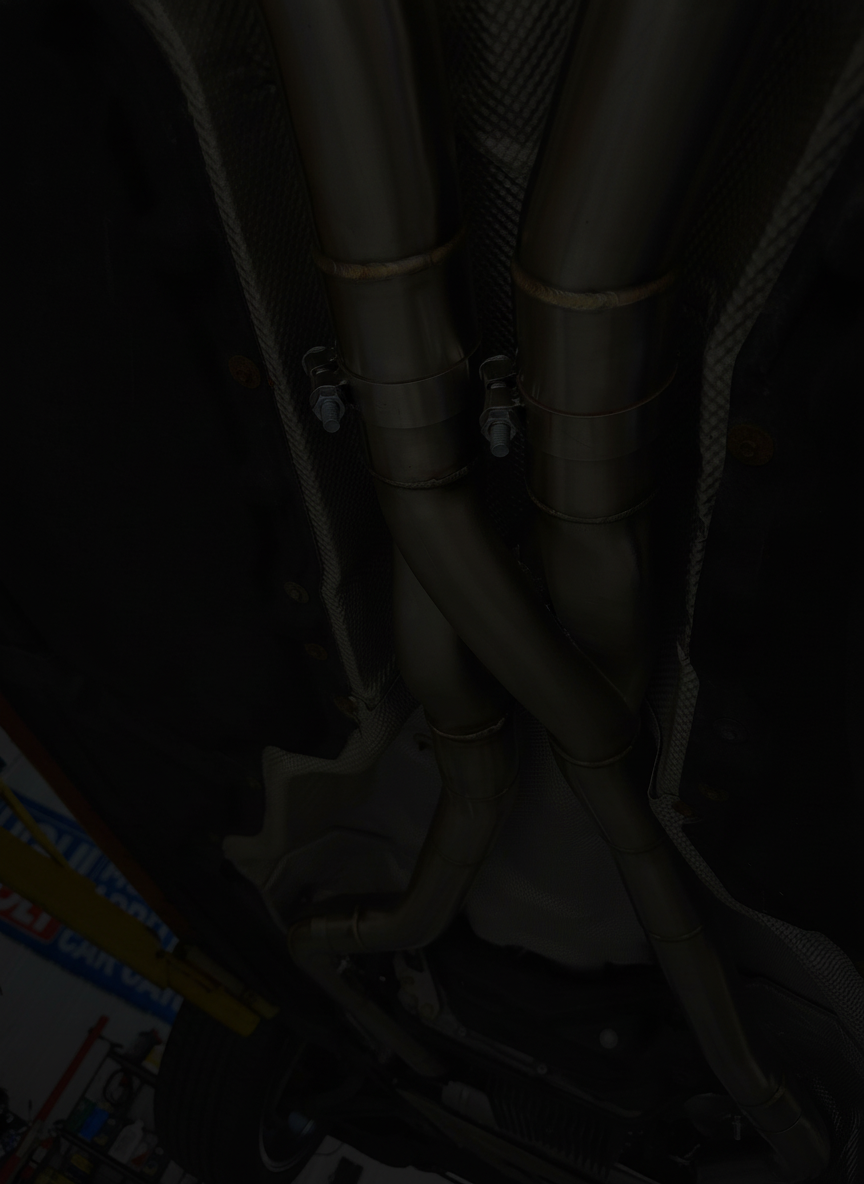
A conventional dual exhaust keeps the cylinder banks separate from the manifold all the way to the tips. Each bank pulses alone, each bank drones alone, and neither bank ever helps the other. A traditional X-pipe merges them — but merges them abruptly, flattening pulse energy and thinning the sound.
Our F1 Technology sits between those worlds. Each bank runs a straight, mandrel-bent leg into a shared crossover junction, then exits on the opposite side. The gas path traces a crossed route: straight, diagonal, straight. Pulses cross the junction, exchange energy between banks, and continue down the pipe — organized, balanced, and uninterrupted.
That single geometric decision drives everything our F1 Technology is known for: how the banks interact, how the pulses behave, how the flow scavenges, and how it sounds.
Crossover Geometry
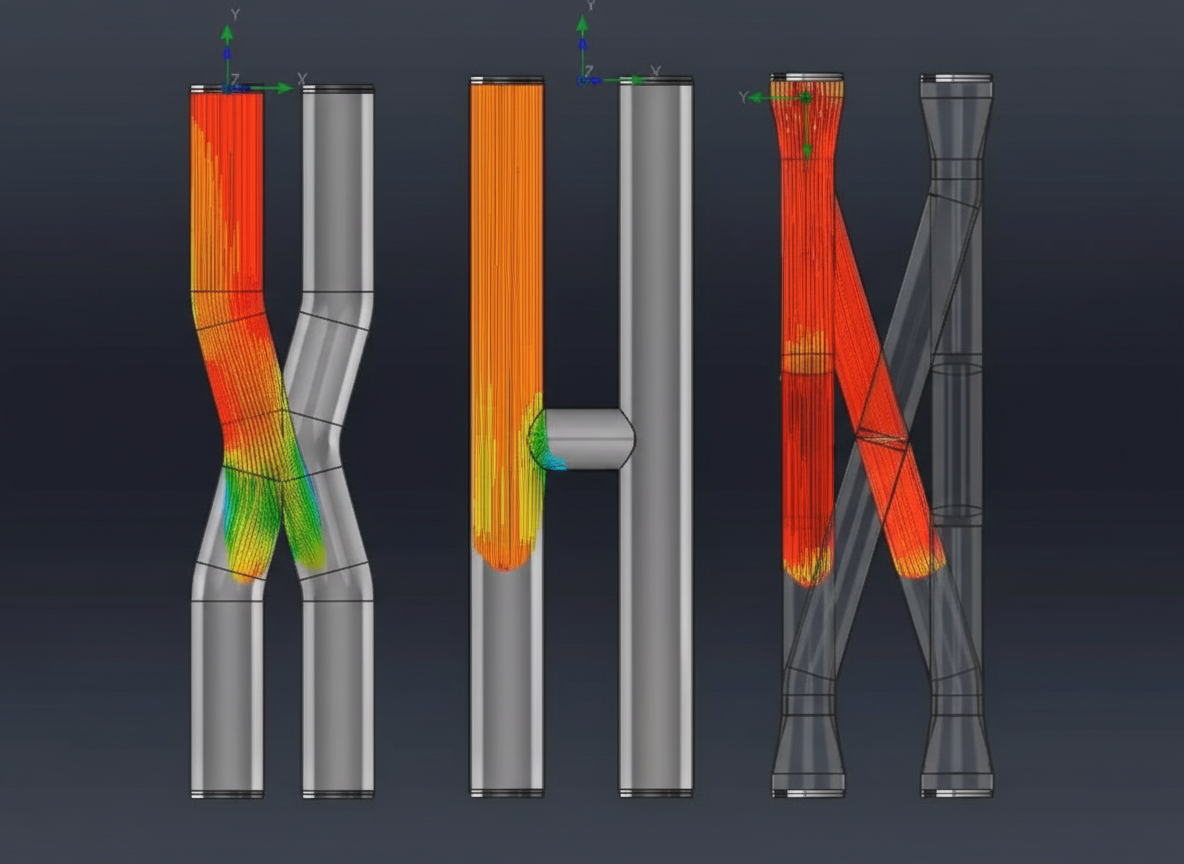
X-pipe, H-pipe, and a true crossed junction. Flow stays attached to the pipe wall through the crossing instead of dumping into a short bridge — that is the geometry our F1 Technology is built on.
01 — Bank Interaction
The banks talk to each other.
In a separated dual system, bank one and bank two never communicate — they fire into dead-end isolation. Our F1 Technology opens a controlled channel between them.
When a pulse from one bank crosses the junction, it momentarily pressurizes the opposite bank leg. The next firing pulse from that bank arrives to meet a prepared, low-pressure path — the banks synchronize instead of fighting.
Pulse Exchange
B—01Every firing event passes through the shared junction. Energy is traded between banks on every cycle, at every RPM — a continuous conversation the separated dual exhaust never has.
Balanced Back Pressure
B—02Because both banks share one junction, back pressure equalizes naturally. No bank runs hotter, louder, or more restricted than the other — critical on cross-plane V engines with uneven bank firing.
Firing-Order Smoothing
B—03The uneven, lumpy firing sequence of a V8 becomes a uniform stream after the crossover. The banks interleave their pulses into an even, ordered flow.
Torque Preservation
B—04Unlike a full merge collector, the crossover junction keeps each bank's velocity high through the crossing. You get the balance of a crossover without the low-RPM torque penalty of a true X merge.
02 — Exhaust Pulse Characteristics
Pressure waves, timed and organized.
Exhaust gas doesn't flow smoothly — it travels as discrete pressure pulses, one per firing event. How those pulses are handled decides everything.
Controlled Pulse Separation
Each cylinder fires into the collector on its own schedule. Our F1 Technology keeps those pressure waves separated long enough to arrive at the crossover in an organized sequence — not as a jumbled, self-cancelling mass.
Negative Wave Timing
When a high-pressure pulse crosses the junction, it leaves a low-pressure wake behind it. The crossover geometry times that wake so it reflects back toward the exhaust valve during overlap — when both valves are briefly open.
Equalized Path Length
Mandrel-bent, equal-length legs mean pulses from both banks arrive at the crossover with the same energy. No bank dominates, no pulse arrives late, and the system stays balanced across the rev range.
The result: instead of random pressure spikes slamming into your mufflers, our F1 Technology delivers a clean, evenly-spaced pulse train. Even pulses mean even flow, even sound, and even power delivery.
03 — Flow Scavenging
The system pulls its own weight.
Scavenging is the quiet superpower of a crossover exhaust. As a pulse crosses the junction and accelerates into the opposite leg, it drags a low-pressure wake behind it. That wake travels back up the pipe toward the cylinder head.
When it arrives during valve overlap — the crank degrees where the intake and exhaust valves are open together — the low-pressure zone helps pull the last burnt gases out of the chamber and draw the fresh charge in. The cylinder starts each cycle cleaner than the last one left it.
More complete evacuation means denser intake charge, more efficient combustion, and power you can feel across the mid range — without touching the engine itself.
- Negative-wave extraction
- Cleaner cylinder fill
04 — Sound Characteristics
The exotic signature.
This is why most people want our F1 Technology — and it's a direct product of everything above. Organized pulses, balanced banks, and controlled crossover create a tone a straight dual exhaust physically cannot make.
Layered and mechanical — the banks trade pulses back and forth through the crossover, producing a synchronized, exotic beat instead of a lazy dual-pipe burble.
The crossover smooths the firing-order chatter into a continuous, turbine-like pull. This is where the F1 Technology balance is most audible — a single, unified tone from two banks.
Crisp, high-frequency exotic rasp with zero drone. Because the pulses are organized, the top end stays sharp and mechanical rather than boomy or washed out.
With the valve actuators closed, the routed flow keeps the tone deep and civilized — neighbor-friendly, without losing the underlying character.
"A dual exhaust sounds like two engines. Our F1 Technology sounds like one engine — thinking."
— Velocity Haus Fabrication
05 — F1 Technology In Motion
See it. Hear it. Live.
Watch the F1 Technology system running — straight from the Velocity Haus build floor. Press play for the full sound signature.
Built on These Principles